

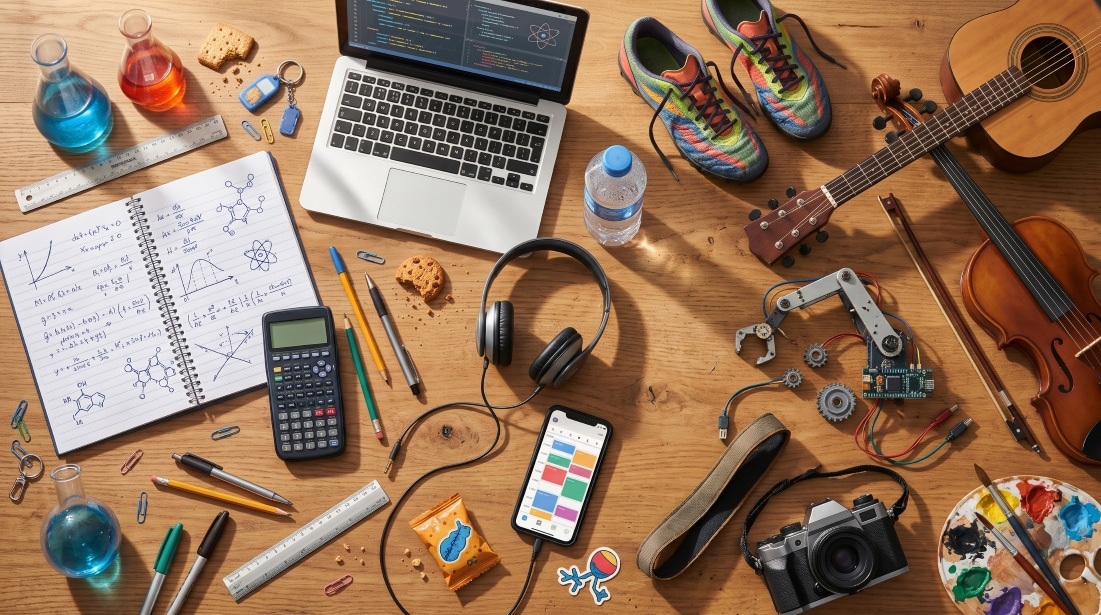
Let’s be real for a second: high school can feel like an endless game of whack-a-mole. You join the robotics club, try out for track, volunteer at the animal shelter, and maybe try to squeeze in a couple of hours playing video games or hanging out with your friends.
Then reality hits: AP Calculus, Honours Physics, or Organic Chemistry enter the chat.
Suddenly, you’re staring at a three-page lab report, two problem sets, and a tournament this weekend, and you find yourself wondering at 1:30 AM why you ever thought taking three STEM classes while running a school club was a viable life plan.
Here’s the good news: you do not have to pick between being a functional human with fun extracurriculars and succeeding in math and science. You just need a completely different approach to managing your time and brain power. STEM subjects play by their own rules, and the study strategies that get you through a history reading simply do not work when you’re wrestling with calculus equations or stoichiometry.
Here is how you juggle a packed extracurricular schedule and success in math and science courses without burning out.
Ditch Passive Review for Active Problem-Solving
In subjects like English or history, you can sometimes get away with skimming a chapter on the bus, highlighting a couple of lines, and calling it good.
Try that in Chemistry or Calculus and you’re going to have a rough exam day.
Math and science are skill-based disciplines, not fact-memorization contests. You learn them the same way you learn to play basketball or shred on the guitar: through reps.
- Stop re-reading the textbook: Highlighting formulas does not mean your brain knows when or how to use them.
- Do unassigned problem sets: Look at the end-of-chapter questions that weren’t assigned. Pick 3 difficult problems and solve them from scratch with your notes closed.
- The “Blank Sheet” test: After learning a major process (like cellular respiration or completing the square), close everything, take out a blank sheet of paper, and map it out entirely from memory. What you can’t draw or derive is what you actually need to study.
By switching from passive reading to focused problem-solving, you cut a two-hour study session down to 45 high-impact minutes.
Leverage “STEM Micro-Sprints” Between Activities
One of the biggest traps high schoolers fall into is waiting for a “free three-hour block” to sit down and do homework. When you have practice from 3:30 to 5:30 PM, debate club from 6:00 to 7:00 PM, and dinner after that, you will never get a clean three-hour block.
Instead, weaponize the awkward 20-to-30-minute gaps in your day:
- The 15-minute bus ride: Review five flashcards on molecular geometry or physics unit conversions.
- The 25-minute gap before practice: Knock out 2 to 3 calculus problems while the concepts from class are still fresh in your head.
- The post-practice cool down: Jot down three questions you need to ask your science teacher tomorrow about the lab you didn’t quite understand.
Knocking out individual problems throughout the day prevents that soul-crushing pileup at 10 PM.
Understand “Conceptual Decay” (The 24-Hour Rule)
In math, chemistry, and physics, topics are strictly cumulative. If you don’t grasp Monday’s lesson on vectors, Tuesday’s lesson on projectile motion will sound like gibberish.
Whenever you sit through a tough STEM lecture, your understanding begins decaying immediately. If you wait until the weekend to look at the material because of soccer games or rehearsals, you will have to relearn everything from scratch.
The Fix: Spend exactly 10 minutes the evening of the lecture doing a fast “reconnaissance pass.” Open the notes, rework one example problem solved in class without looking at the solution, and mark any step that confuses you. This single habit cements the synaptic pathway and prevents weekend panic.
Build an Error Log Instead of Re-Studying Everything
When an exam is coming up and you have rehearsal until late evening, you don’t have time to re-solve 50 practice problems. You only need to practice the things you’re prone to messing up.
Keep a dedicated notebook or digital doc called your Error Log. Every time you get something wrong on a quiz, homework, or practice problem:
- Copy down the problem.
- Write the exact step where your logic failed (e.g., “Forgot to distribute the negative sign across parentheses” or “Used the wrong gas constant because units were in Celsius, not Kelvin”).
- Write the rule or checkpoint to prevent it next time.
Right before your midterm or final, while everyone else is frantically flipping through 200 textbook pages, your entire review is simply reading your Error Log. It’s personalized, fast, and addresses your exact weaknesses.
Treat Sleep as a Cognitive Performance Enhancer
Staying up until 2:30 AM to finish a lab report before a calculus test is a trap. Math, chemistry, and physics are analytical disciplines that require working memory, pattern recognition, and logical reasoning—the very first cognitive functions degraded by sleep deprivation.
If you are sleep-deprived:
- You will misread straightforward problem-prompts.
- You will drop negative signs and make basic calculation blunders.
- You will spend 40 minutes on a problem that should take 10.
If it’s past midnight and you’re stuck on a proof or balancing a complex redox equation, close the laptop and go to sleep. Wake up 30 minutes earlier if necessary; your rested brain will spot the solution in a fraction of the time.
Communicate Early with Coaches, Advisors, and Teachers
High school teachers and coaches are usually far more accommodating than students expect—provided you talk to them before a crisis happens, not after.
If you know you have an away tournament on Thursday and an AP Biology lab due on Friday, talk to your biology teacher on Monday:
“Hey, we have a tournament this Thursday that will keep me out late. Can I turn the data analysis in early on Thursday morning, or come in during lunch on Wednesday to clarify questions?”
Teachers respect proactive planning. It proves you care about their class and aren’t using your activity as a last-minute excuse.
Work Smarter, Not Longer
Balancing heavy STEM coursework with activities outside the classroom isn’t about sacrificing your sanity or living on energy drinks. It’s about recognizing that math and science require active, short-burst reps, cumulative consistency, and a well-rested brain.
Protect your sleep, work problems actively in short intervals, track your errors ruthlessly, and you’ll have plenty of bandwidth left over to excel on the field, the stage, or wherever your extracurriculars take you.
We are here to help
At Sealy Tutoring, we understand that balancing extracurricular activities and academics is an ongoing challenge. That’s why, we’ve created specialized programs that allow students to fit tutoring into their hectic schedules, so they can get the support that they need on their terms.
Looking for tutoring for your math and science subjects? Contact us today to learn more about our math and science tutoring programs!